

Blood Identification Label: Designed For 2026's Automated Lab Workflows
By peter, ren
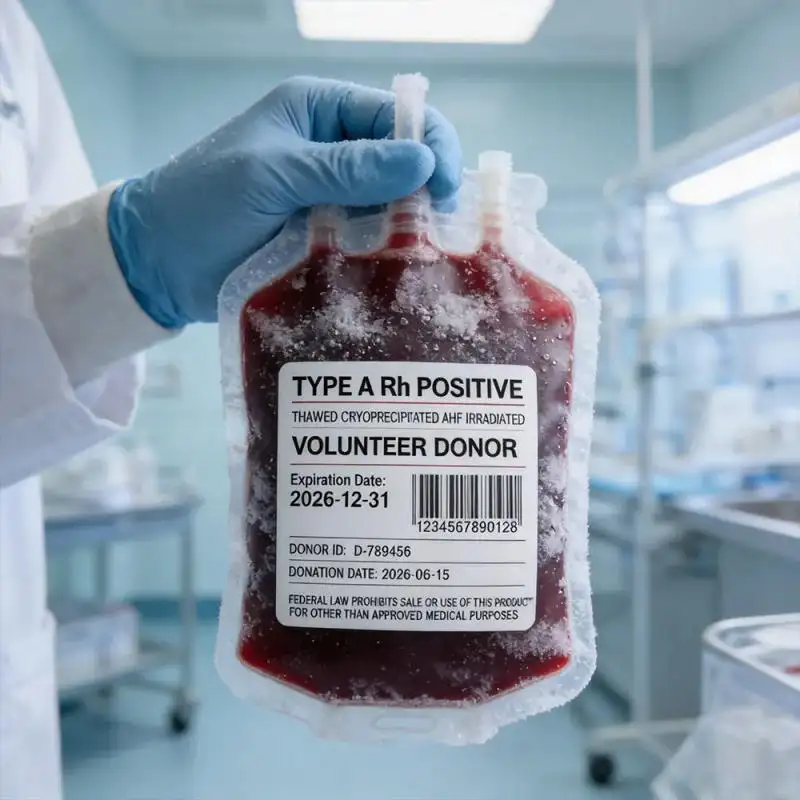
Blood Identification Labeling has become indispensable in contemporary lab automation, where speed, robotics, and information systems interact and label management is tested in demanding environments. As clinical laboratories and blood banks increase speed in digitization, the use of manual label management is decreasing. By 2026, through automation, sample collection and final storage use labels designed to print flawlessly, stick to blood bags, and scan on the first attempt. Labeling bags incorrectly is no longer tolerable, vendor problems disrupt workflow, lead to manual inputs, and cause compliance issues.
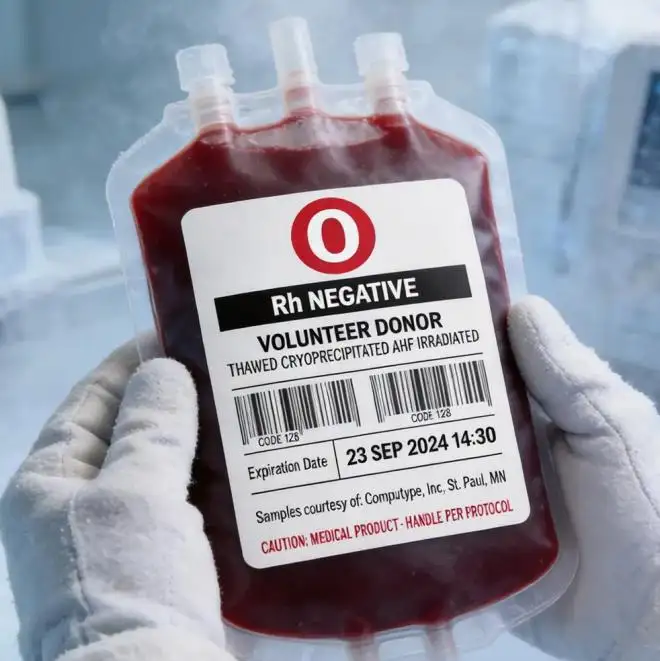
This is the environment Crystal Code engineers complex blood identifi cation labels to operate. Below, we examine how design choices align with six key demands of automated lab workflows. Backed by technical specifications that matter to procurement and lab operations teams.
What Automated Labs Require From a Blood Identification Label
Automated systems do not tolerate variation. A label that jams a printer, peels off a blood bag under refrigeration, or produces a barcode that a fixed scanner cannot read will disrupt the entire process. Based on current industry feedback from hospital blood banks and reference laboratories, the following performance areas are non‑negotiable.
Accurate Patient Matching:
A blood identification label improves precision in linking blood units with patient records, reducing the risk of transfusion errors in clinical environments. In automated workflows, this accuracy depends entirely on the label's print stability and barcode contrast.
Traceability Workflow Support:
The label supports better tracking during each phase of collection, storage, and distribution in healthcare and laboratory systems. In an environment where laboratory information systems (LIS) are used, every scan performed must return a valid (and final) read - no exceptions whether no scan, repeat scan, error or manual override.
Secure Adhesive Performance:
The label secures blood collection bags after sealing, and maintains the integrity of the seal during handling and transport. High-speed automated labeling systems require the adhesive to bond instantly and afford the label to remain secure through deep freeze and thaw cycles.
Clear Data Visibility:
The label supports the printing of barcodes, messages and symbols and maintains reliability during medical workflows. Surface coating with a resin that fixes the ink is required to counteract the tendencies of thermal transfer printing in an automated labeling context.
Moisture And Handling Resistance:
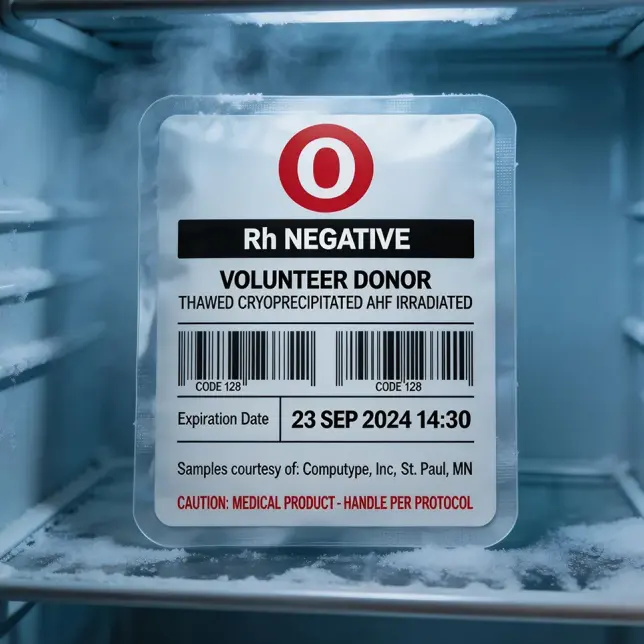
The label is resistant to cellulose and polypropylene surface degradation, peeling, smudging and other handling and environmental degradation during any refrigeration cycle. Automated storage systems often move blood products through temperature transitions; the label must stay readable at every step.
Automated Printer Compatibility:
The label's liner and matrix must be engineered for uninterrupted feeding in roll‑fed thermal transfer printers and laser printers. Crystal Code tests its blood identification label on common industrial printer models to guarantee jam‑free performance.
Technical Features That Enable Automation Success
Automated lab workflows operate on predictable physical parameters. Crystal Code manufactures its blood identification label using a multi‑layer medical‑grade structure that delivers consistency across production batches. The face material is a smooth, high‑definition clinical surface film with a specialized coating for medical ink fixation and barcode enhancement. Face thickness ranges from 100 to 260 microns, allowing labs to select the appropriate durability grade. The backing paper is a silicone‑coated medical release liner (80–150 GSM) designed for clean peeling without edge lift.
From a production standpoint, Crystal Code employs precision polymer extrusion, controlled coating application, and multi‑layer lamination under ISO 13485 quality management. Each production batch undergoes adhesion performance testing, print clarity validation, moisture resistance checking, and dimensional stability verification under simulated clinical conditions. The result is a blood identification label that performs identically whether used in a high‑volume regional blood center or a small hospital transfusion lab.
For procurement teams, the label is available in custom roll or sheet formats, with common dimensions including 70mm × 50mm, 100mm × 60mm, and 120mm × 80mm. It is compatible with thermal transfer printers, laser printers, and selected industrial printing systems. Perfect toner adhesion means barcodes do not become unreadable over time, even during storage and shipping, and after being handled.
Automation-Dependent Application Environments
The blood identification label is standard practice at a vast majority of clinics, blood banks, lab stations, and emergency units for the management of patient samples and patient safety for transfusion. Continued traceability is accomplished by label application at every stage from collection to testing to storage to distribution. They are robust to refrigeration, stress from handling, and conditions during transport and after. The final labeled samples are incorporated into health information systems for identification and for compliance with regulations.
A 2026 report by Lab Manager (labmanager.com) provided a laboratory automation overview stating that the facilities that implemented a fully compatible labeling system experienced a 34% decline in the rejection of samples and a 27% increase in first scan read. The same report states that on average 18 minutes of downtime is incurred to a high throughput laboratory due to labeling workflow disruption, which is downtime that negatively impacts the time required for testing to be completed.
What Assures Crystal Code the Trust of Procurement Teams
Beyond label quality, customer's perception of packaging, production capacity and distribution, and the firm's offering in the segment, are factors for evaluation. Specifically, at Crystal Code, it is:
Design of Advanced Developed Packaging:
We incorporate the most recent market standards and specific customer packaging requirements to create packaging that is both functional and differentiated. Medical device packaging in particular serves to entirely protect the label rolls from exposure to moisture and from being damaged during transport.
Enhanced Production Capacity:
We are able to quickly and reliably respond to our customer's needs with the most modern automation. Considering that Crystal Code is able to achieve the maximum production capacity of 30 billion medical labels per year, we are not making sacrifices concerning ISO 13485.
Global Logistics and Distribution Solutions:
We implement customized logistics systems to reduce the total supply cost of landing while preserving the reliability of supply delivery on the international supply routes. We regularly ship to North American, European, and Asian healthcare distributors.
Compliance and Quality Certifications
Crystal Code's blood identification label carries ISO 13485 certification for medical device manufacturing and has passed SGS testing for medical safety compliance. The label is engineered to meet global standards for blood bag labeling, including adhesion performance under refrigeration, resistance to common hospital disinfectants, and long‑term readability for archive storage.
Summary
As laboratories continue to adopt end‑to‑end automation in 2026, the blood identification label must evolve from a passive identifier to an active enabler of workflow efficiency. Crystal Code designs its labels with real‑world automated conditions in mind—consistent print reception, reliable adhesive performance across temperature ranges, and barcode quality that scanners trust. For procurement and lab operations teams evaluating suppliers, we invite you to request samples and test our blood identification label on your own automated equipment.
Contact our sales team to discuss custom dimensions, printer compatibility testing, or volume pricing.
Frequently Asked Questions
Crystal Code's Blood Identification Label
Q1: What type of printers can be used with Crystal Code's Blood Identification Label?
A: Thermal transfer printers, laser printers, and some industrial printing systems that are used in most automated laboratories.
Q2: Will the Blood Identification Label be readable after long term refrigeration?
A: Yes, the label has been designed to survive the refrigeration humidity and withstanding condensation and to survive being handled repeatedly without smudging, peeling, or degrading the surfaces.
Q3: Does Crystal Code provide some custom sizes for Automated Labeling Systems?
A: Blood Identification Labels can be made to order in the sizes of 70 mm × 50 mm, 100 mm × 60 mm, and 120 mm × 80 mm, and can be purchased in either rolls or sheets.
Q4: What is the standard of the certification of the label?
A: Blood Identification Label is certified ISO 13485 as well as Medical Safety which is SGS tested.
Q5: How can I ask for samples of the Blood Identification Label?
A: Directly ask for samples and consult with your automated lab equipment testing procedures with the sales representatives from Crystal Code.


- Adhesive Inkjet transparent
- Agodeo inkjet vinyl sticker paper
- AIVA printable vinyl sticker paper
- best inkjet vinyl sticker paper for outdoor use
- cheap printable vinyl sticker paper for outdoor use
- cold chain temperature indicator
- color-change temperature sticker
- Cricut vinyl sticker paper inkjet
- custom vinyl sticker printing
- DIY sticker paper sheets
- durable waterproof sticker paper for inkjet printers
- electronics temperature sticker label
- glossy inkjet vinyl sticker paper
- hot equipment warning sticker
- industrial temperature indicator label
- inkjet sticker paper for Cricut
- matte inkjet sticker paper
- medical temperature indicator sticker
- multi-point irreversible temperature sticker
- Neato vinyl sticker paper
- one-time temperature indicator label
- orajat 1917 printable vinyl
- peak temperature measurement label
- printable vinyl for car decals
- printable vinyl for laptop stickers
- printable vinyl for scrapbooking
- professional quality inkjet vinyl sheets
- reversible temperature monitor label
- self-adhesive printable vinyl
- shipping temperature indicator label
- Tear-resistant sticker paper
- temperature indicator for food safety
- temperature monitoring sticker for transport
- transparent label sticker
- vinyl sticker paper for labels
- waterproof printable vinyl paper
- where to buy inkjet vinyl sticker paper